
When wind and water both damage a Jacksonville home, two different policies usually come into play. Rising water, including storm surge pushed in from the ocean or up the St. Johns River, is flood, and it is covered by flood insurance, not by a standard home policy. Wind falls under your home policy and its deductible. This guide explains how the two policies divide the damage, how the deductibles work, when a flood policy starts, and where to look up your own home’s water risk.
A licensed member of our team may be able to compare options from the insurance companies we represent.
Two kinds of damage, two policies
Wind can tear off shingles and break windows, and many home policies also respond to rain that gets in through an opening the wind creates, but that wording varies by policy form, so read yours. Surge from the ocean, river flooding and flooding from heavy rain are forms of rising water, and insurance treats them as flood. FEMA’s FloodSmart site puts it plainly: “Most homeowners and renters insurance does not cover flood damage.”
A home policy that doesn’t include flood coverage must say on its declarations page, in bold type of at least 18 points, that it “does not include coverage for damage resulting from flood even if hurricane winds and rain caused the flood to occur” (section 627.7011(4)(b), Florida Statutes). In general, then, the home policy responds to wind and the flood policy responds to rising water. The exact wording of your policies decides.
What the home policy pays, and how its deductible works
Wind damage to the roof, windows, doors and siding generally falls under the home policy, subject to its deductible. Many Florida home policies carry a separate hurricane deductible, and Florida law sets the rules for it in section 627.701, Florida Statutes.
- The choices. Before issuing a personal residential policy, the insurer must offer hurricane deductible options of $500, 2%, 5% and 10% of the dwelling limit, with some exceptions.
- The dollar amount. The insurer must show the deductible’s actual dollar value on the declarations page, or for a renewal on the renewal declarations page or premium renewal notice.
- Once per calendar year. For policies issued or renewed on or after May 1, 2005, the hurricane deductible applies on an annual basis, once per calendar year across covered hurricane losses under policies from the same insurer or insurer group.
- A later loss in the same year. The insurer may apply the greater of the hurricane deductible still remaining or the deductible for other perils.
- Keep records of smaller losses. Insurers may ask you to report losses that fall below that deductible, or to keep receipts or other records of them, so they can count toward a later claim that year.
Your home policy’s deductible and your flood policy’s deductible are usually separate, so one event can involve both. Our Jacksonville home insurance page covers more on local coverage questions.
What a flood policy pays
Flood coverage comes from the National Flood Insurance Program (NFIP) or from private insurers. FloodSmart describes NFIP coverage this way:
- Building coverage up to $250,000 and contents coverage up to $100,000 for belongings kept inside your home.
- Building and contents coverage are typically bought separately and have separate deductibles.
- Valuable items such as original artwork and furs are covered up to $2,500 under contents.
- Not covered: temporary housing and additional living expenses while your home is repaired, property outside the building such as landscaping, decks, patios, fences and pools, cars, and belongings in a basement.
Private flood policies from authorized insurers are written under section 627.715, Florida Statutes, which lets them offer standard, preferred, customized, flexible or supplemental flood coverage. A “preferred” flood policy must also cover water intrusion from outside the home beyond the NFIP’s flood definition, cover additional living expenses, and adjust contents at replacement cost. Our guide to NFIP vs. private flood insurance compares the two, and how flood premiums work explains pricing.
When a new flood policy starts
FloodSmart says NFIP coverage goes into effect 30 days after your date of purchase, with four exceptions:
- No wait if you buy the policy when you make, increase, extend or renew a mortgage.
- No wait if you change your flood coverage while renewing your policy.
- A one-day wait if you buy a flood policy during the 13 months after a revised flood map takes effect for your community (44 CFR 61.11(a)).
- A one-day wait for flooding caused or worsened by a wildfire on federal land, if you buy in the 60 days after the fire is contained.
In practice, a new NFIP policy generally isn’t in force during its first 30 days. Waiting periods on private flood policies vary by policy, so ask before you rely on a start date. As of October 30, 2026, FEMA’s proposed flood maps for Jacksonville are preliminary, and our post on Jacksonville flood map changes tracks where they stand. The one-day map-change rule applies only once a revised map takes effect.
How one event becomes two claims
When wind and flood both damage a home, each insurer adjusts its own part. FEMA’s NFIP Claims Manual (June 2025) tells the flood adjuster to separate the work into two parts, one for flood and one for the other peril, and to document wind and wind-driven rain damage apart from flood damage, using photos of the interior and exterior waterlines. If the flood damage overlaps or borders the other damage, the manual says the flood adjuster should contact the other adjuster, and it calls for avoiding duplicate claims for the same items under multiple policies.
Citizens Property Insurance Corporation, Florida’s state-created insurer, has a specific rule here. As of the 2026 Florida Statutes, section 627.351(6)(kk) says a Citizens policyholder making a water damage claim against Citizens has the burden of proving the damage was not caused by flooding.
A few habits make a two-policy claim easier to document:
- Keep current photos and video of your home and belongings, inside and out.
- After a loss, photograph the waterline inside and outside before cleanup.
- Report the loss to both insurance companies, and give each one the other’s claim information.
- Ask your adjusters before you throw out damaged items.
Citizens and the flood coverage requirement
As of October 30, 2026, section 627.351(6)(aa), Florida Statutes, requires Citizens personal residential policyholders to have flood coverage in place, bought from an insurer other than Citizens, on a phased schedule based on the policy’s effective date:
- On or after January 1, 2024: dwelling replacement cost of $600,000 or more.
- On or after January 1, 2025: $500,000 or more.
- On or after January 1, 2026: $400,000 or more.
- On or after January 1, 2027: the remaining Citizens personal residential policies.
Homes in a FEMA Special Flood Hazard Area already had the requirement, for new policies from April 1, 2023, and renewals from July 1, 2023. Policies that exclude wind coverage and condominium unit owner policies are exempt. The flood coverage must meet, at a minimum, the dwelling coverage available from the NFIP or the requirements of section 627.715(1)(a)1., 2. and 3., Florida Statutes. Our page on the Citizens 2027 flood requirement has the details.
Look up your own home’s water risk
Your evacuation zone is not your flood zone, so look up both.
- Evacuation zone. JaxReady, the City of Jacksonville’s emergency preparedness site, uses zones A through F. Zone A is evacuated first, along with manufactured and mobile homes, evacuations widen from Zone B through Zone E as needed, and Zone F covers areas likely to flood from rainfall or other hazards. JaxReady notes that Duval’s zones reflect how its rivers interact with the Atlantic Ocean. You can look up an address with the City of Jacksonville evacuation zone search.
- Flood zone. FEMA’s Flood Map Service Center shows the flood zone that insurers and lenders use. Being outside a high-risk zone doesn’t mean a home can’t flood, as our post on flood insurance outside a flood zone explains.
- NHC planning maps. NOAA’s National Hurricane Center publishes its National Storm Surge Risk Maps, built with its SLOSH model, that show a near worst-case scenario of surge flooding at high tide. NHC says storm surge “is not just a beachfront problem” and can extend many miles inland in some areas, and it lists tidal rivers among the places at risk. These are planning maps, separate from FEMA’s flood insurance rate maps, and this guide doesn’t quote water depths for any street.
Irma (2017): river flooding far from the beach
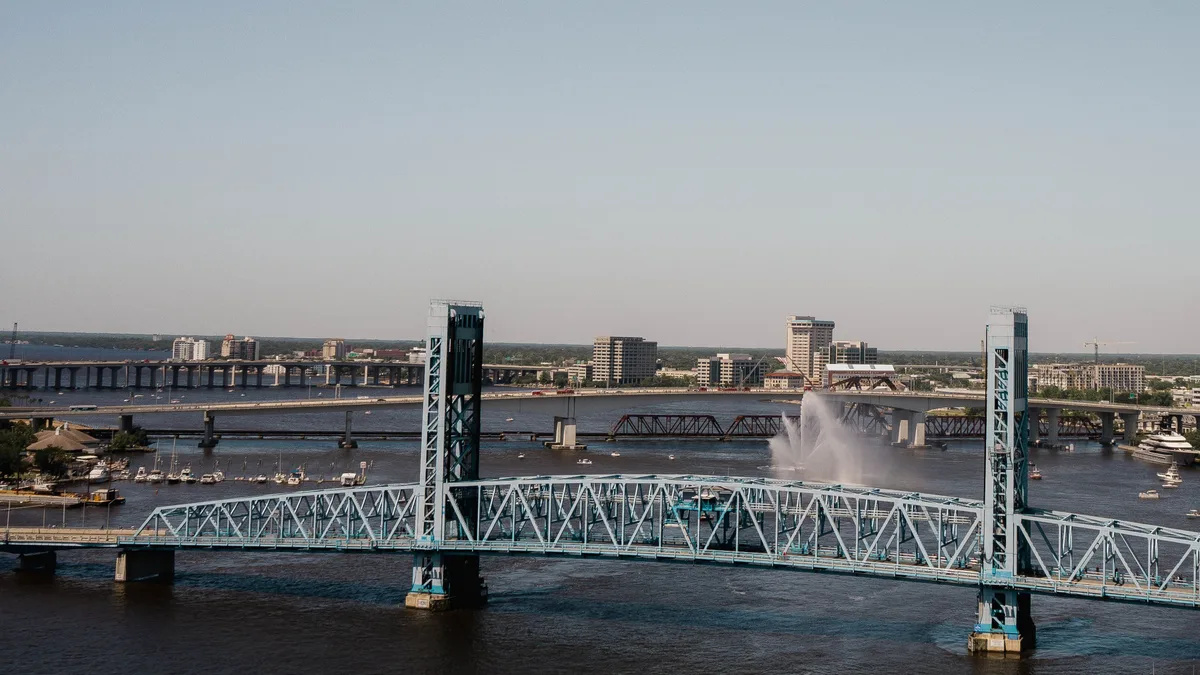
Irma in September 2017 shows how wind and water can arrive in different places. According to the National Weather Service’s Jacksonville report on the event, the St. Johns River gauge at the Main Street Bridge downtown crested around 12:30 PM on September 11, 2017, at 5.57 feet (NAVD88), which NWS called a record stage. The earlier record there was 4.12 feet, set in 1964. NWS tied the flooding to a combination of high water left by a nor’easter, high astronomical tides, river surge and Irma’s rainfall. About 350 water rescues were made in Duval County, “especially in the Riverside, San Marco and downtown Jacksonville areas,” the report says.
At the coast, the Mayport tide gauge recorded 6.44 feet of surge, and the Mayport weather station measured a sustained wind of 68 mph with an 87 mph gust. So the same event brought strong wind at the beaches and record flooding on the river miles inland, which is why both policies matter. A past flood doesn’t predict the next one, in either direction.
Want a second look at how your home and flood policies fit together? Call (352) 371-7977 or request a quote, and a licensed member of our team can walk through your options. You can also start at our flood insurance hub.
Frequently asked questions
Does my home policy cover storm surge in Jacksonville?
Generally, no. Storm surge is rising water, which insurance treats as flood, and Florida law requires a home policy without flood coverage to say so on its declarations page. Flood damage is covered by a flood policy from the NFIP or a private insurer.
If wind damages my roof and rising water floods the first floor, who pays for what?
In general, the home policy handles the wind damage, subject to its deductible, and the flood policy handles the rising water damage, subject to its own deductible.
Can I pay two deductibles for one event?
Yes, it’s possible. The home policy and the flood policy each have their own deductible, and FloodSmart says NFIP building and contents coverage typically have separate deductibles too.
I live on the river, not the beach. Should I think about flood coverage?
It’s worth reviewing. NHC says storm surge “is not just a beachfront problem,” and in 2017 the National Weather Service recorded a record crest on the St. Johns River at the Main Street Bridge downtown during Irma. A licensed member of our team can walk through it with you.
Is my evacuation zone the same as my flood zone?
No. JaxReady’s zones A through F guide evacuations, while FEMA’s flood maps show the flood zone insurers and lenders use, so look up both.
When does a new flood policy start?
FloodSmart says NFIP coverage goes into effect 30 days after purchase, with exceptions, such as no wait when the policy is bought with a mortgage closing or a change at renewal. Private flood waiting periods vary by policy.
General information, not legal or coverage advice. Coverage depends on the policy issued, its terms and underwriting. Sources checked October 30, 2026. McGriff-Williams Insurance is an independent insurance agency in Gainesville, in business since 1983 and licensed in Florida. We are not affiliated with FEMA, the NFIP or Citizens Property Insurance Corporation.
Sources
- Fla. Stat. s. 627.701 (2026), hurricane deductibles: https://www.flsenate.gov/Laws/Statutes/2026/627.701
- Fla. Stat. s. 627.7011 (2026), subsection (4)(b), declarations page flood statement: https://www.flsenate.gov/Laws/Statutes/2026/627.7011
- Fla. Stat. s. 627.715 (2026), private flood insurance: https://www.flsenate.gov/Laws/Statutes/2026/627.715
- Fla. Stat. s. 627.351 (2026), paragraphs (6)(aa) and (6)(kk), Citizens: https://www.flsenate.gov/Laws/Statutes/2026/627.351
- FEMA FloodSmart, What's covered and when coverage begins: https://www.floodsmart.gov/whats-covered
- FEMA, NFIP Claims Manual (June 2025), Handling a Claim with Multiple Perils: https://nfipservices.floodsmart.gov/sites/default/files/media/document/2025-08/fema_nfip-ClaimsManual-June2025-508c.pdf
- JaxReady, Know Your Zone (evacuation zones): https://www.jaxready.com/alerts/evacuation-zones
- City of Jacksonville, evacuation zone search: https://maps.coj.net/evsearch/
- NOAA National Hurricane Center, National Storm Surge Risk Maps, Version 4: https://www.nhc.noaa.gov/nationalsurge/
- National Weather Service Jacksonville, preliminary post-tropical cyclone report on Irma (September 2017): https://www.weather.gov/media/jax/TropicalEventSummary/Irma_PSH.pdf
- 44 CFR 61.11, Effective dates: https://www.ecfr.gov/current/title-44/chapter-I/subchapter-B/part-61/section-61.11
- FEMA Flood Map Service Center: https://msc.fema.gov/portal/home