
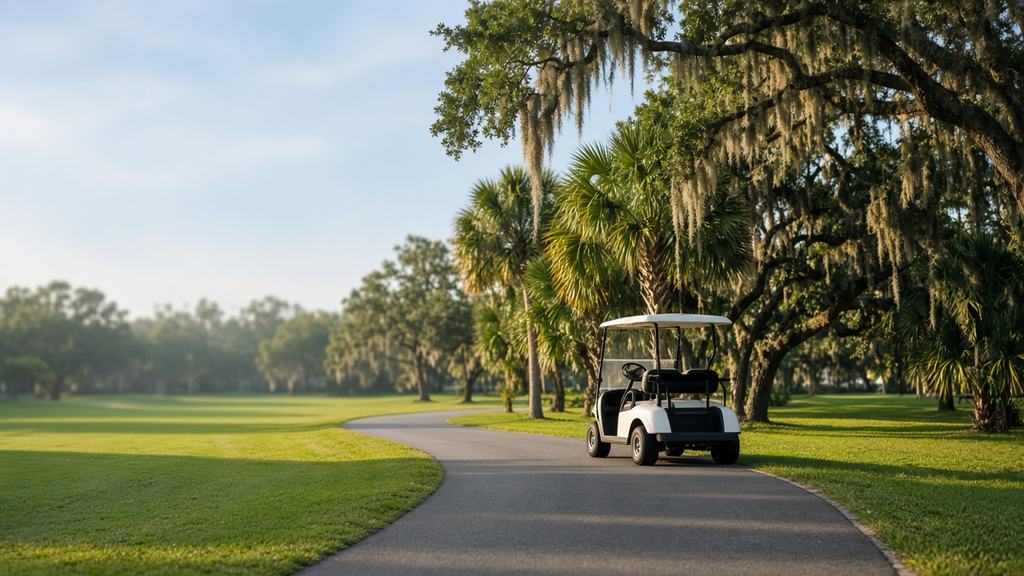
In and around The Villages, a golf cart is often how people get to the pool, the town square or a friend’s house. The Villages’ own FAQ says there are about 1.5 golf cars per home, with paths, tunnels and bridges built for them (The Villages FAQ). If yours is a daily driver, it’s worth knowing how it’s insured and what the local rules expect.
McGriff-Williams Insurance is an independent insurance agency in Gainesville, in business since 1983 and licensed in Florida. We work with clients by phone, email and video. This page covers what’s local to The Villages. For Florida’s statewide rules on golf carts, low-speed vehicles, motorcycles and ATVs, see our motorcycle, ATV and golf cart insurance page.
Golf cart or LSV? Know which one you have
Florida treats these as two different vehicles, and that changes how they’re insured.
- Golf cart: built for golf course use and can’t go faster than 20 mph. Florida doesn’t require a golf cart to be registered or insured.
- Low-speed vehicle (LSV): a four-wheeled vehicle with a top speed over 20 mph and no more than 25 mph, built to federal LSV safety standards. An LSV must be titled, registered and plated, and it must carry Florida personal injury protection (PIP) and property damage liability (PDL), at least $10,000 of each.
Has your cart been modified to go faster than 20 mph? Then it may no longer count as a golf cart. Sumter County’s code says a cart modified to go faster than 20 mph isn’t treated as a golf cart under the county’s golf cart rules. Other local governments, such as the City of Wildwood, have their own rules, so check before you drive. A cart converted to an LSV through the state’s process gets a state-assigned VIN and a plate. If you’re not sure which one you have, talk with us before you drive it on a public road.
Getting around: whose rules apply?
The Villages includes roads that the counties, the cities (such as Wildwood) and the community’s development districts control. Under Florida law, a golf cart may use a public road only where the responsible local government allows it, such as on roads it has designated and signed, or within a self-contained retirement community, unless the county or city has prohibited it there. That means the rules can change from one road to the next, so follow the signs.
The Villages’ district government publishes these rules of the road for golf cars:
- Golf car drivers need valid government-issued photo ID. Drivers under 18 need a valid driver’s license or learner’s license. Florida law says the same for golf carts on public roads.
- Don’t go over 20 mph, and use hand or turn signals.
- Yield to cars and come to a full stop at stop signs.
- Never enter a roundabout in a golf car.
- Golf cars are prohibited on roads posted at 35 mph or more.
- Golf cars are subject to Florida’s open-container laws.
The multi-modal paths are for pedestrians, bicycles and golf cars. Cars, motorcycles and mopeds (unless pedaled) are not allowed. According to the districts’ counsel, registered LSVs may use the paths, but vehicles that look like golf cars and can go faster than 25 mph may not. The memo adds that the paths aren’t designed for speeds over 20 mph. It also notes that some tunnels have limited clearance, so measure a lifted cart or a new roof before you drive through.
After dark: Under Florida law, a golf cart may run only from sunrise to sunset unless the local government allows night use and the cart has headlights, brake lights, turn signals and a windshield. Sumter County’s code also lists reflective devices on the sides.
Visiting grandkids: Anyone under 18 driving a golf cart on a public road needs a learner’s license or driver’s license. An LSV is different: anyone driving an LSV must have a valid driver’s license with them. A guest driving your cart is also something to ask about on your policy (see below).
What insurance covers on a golf cart or LSV
Policies differ, and what’s available depends on the vehicle and the insurance company. These are the coverages to ask about:
- Liability (bodily injury and property damage). Pays for injuries or damage you cause to others, plus your legal defense, up to your limits. It’s a key coverage if your cart is around pedestrians, cyclists and other carts every day.
- Guest passenger coverage. Covers injuries to people riding with you. On some policies it’s part of liability, and on others it’s a separate limit.
- Medical payments. Helps pay medical bills for you and, on many policies, your passengers after a covered accident, regardless of fault, up to the limit. On an LSV, it can sit alongside the required PIP.
- Uninsured/underinsured motorist. Helps pay for your injuries when an at-fault driver has no insurance or not enough. Some golf cart policies offer it. On an LSV’s auto policy, ask how it works with your other coverage.
- Collision. Pays to repair your cart after it hits something or overturns, minus your deductible.
- Comprehensive. Pays for theft, vandalism, fire and other covered damage that isn’t a collision, minus your deductible.
- Custom parts and accessories. Lift kits, upgraded seats, enclosures, sound systems, custom wheels and paint can add up. Many policies include a set amount for accessories, and you can often buy more. Make sure your limit matches what you’ve added.
How each is usually insured. A separate golf cart policy is often written on a policy form designed for motorcycles and powersports vehicles. LSVs are different: in Florida, a registered LSV needs auto-type coverage, with PIP and PDL on an auto policy that lists it.
Does my home policy cover my golf cart?
It depends on your policy’s wording, and every home policy’s golf cart wording is a bit different. Many Florida homeowners policies don’t cover golf carts at all. Some include limited golf cart coverage, and some home insurers offer a golf cart endorsement you can add. A golf cart endorsement may have its own limits and conditions, and it may apply only in certain places. Where coverage exists, it’s usually limited to narrow situations, such as using the cart on a golf course, and may apply only to carts that seat four or fewer and haven’t been modified to go faster. It may not cover someone else driving your cart away from your home, and damage to the cart itself usually isn’t covered by the home policy; some insurers offer a separate add-on for damage to the cart, with a set limit. Don’t assume your home policy covers your cart.
Depending on your situation and your home policy’s wording, for most owners we recommend a separate golf cart policy. It’s written for the cart itself and can include liability, guest passenger, medical payments, collision, comprehensive and accessories coverage, so you aren’t relying on how your home policy’s wording applies. Send us your home policy and we’ll go through it with you.
LSVs are different. In Florida, a registered LSV needs auto-type coverage, with PIP and PDL on an auto policy that lists it. Your home policy isn’t how you meet that requirement, and home policies generally exclude liability for vehicles registered for road use.
Questions to ask before you drive
- Is my vehicle a golf cart or an LSV, and is it titled and registered correctly?
- Has it been modified to go faster, and does my policy know about the changes?
- Do I have liability limits I’m comfortable with, and do I have guest passenger coverage?
- Who’s allowed to drive it under my policy (a spouse, visiting family, a neighbor)?
- Are my accessories covered for what they’re worth?
- Does my personal umbrella require certain limits on the cart’s policy? See our personal umbrella page.
FAQ
Do I need insurance on a golf cart in Florida?
Florida doesn’t require it for a golf cart, which by law can’t go faster than 20 mph and isn’t registered. Liability and physical damage coverage are still worth considering, often on a separate golf cart policy, and they can matter if your cart hurts someone or damages property.
What insurance does an LSV need?
A registered LSV must carry at least $10,000 of personal injury protection (PIP) and $10,000 of property damage liability (PDL). Many owners add more, such as bodily injury liability and collision.
Can I drive my golf cart on any road in The Villages?
No. Golf carts may use only roads where the county or city responsible for that road allows them, or inside a retirement community where they haven’t been prohibited, so the rules can change from one road to the next. Follow the posted signs. The districts’ rules prohibit golf cars on roads posted at 35 mph or more and in roundabouts.
Can my grandchild drive my golf cart?
On a public road, a driver under 18 needs a learner’s license or driver’s license. Check your policy too: some policies limit who’s covered behind the wheel.
Will my homeowners policy cover a golf cart accident?
It depends on your policy’s wording. Many Florida homeowners policies don’t cover golf carts, and those that do usually limit the coverage and may not cover damage to the cart itself. Some home insurers offer a golf cart endorsement. Depending on your situation and policy wording, for most owners we recommend a separate golf cart policy. A registered LSV is different: it needs PIP and PDL on an auto policy that lists it. Ask us to review your policy.
Let’s review your coverage
Have a golf cart or LSV in or around The Villages? We’ll review your cart, home and auto coverage together and explain any gaps in plain English. A licensed member of our team may be able to compare options from the insurance companies we represent. What’s available depends on the vehicle, how it’s used and where it’s kept. Call (352) 371-7977 or contact us.
General information, not legal or coverage advice. Coverage depends on the policy issued, its terms and underwriting. Road and path rules are set by Florida law and local governments and can change, so follow posted signs and local rules. McGriff-Williams Insurance is an independent insurance agency licensed in Florida. We are not affiliated with The Villages, its developer or its community development districts. The Villages is a registered trademark of Holding Company of The Villages, Inc. Information is as of October 29, 2026.
Sources
- Fla. Stat. 316.212, golf carts (2026): https://www.flsenate.gov/Laws/Statutes/2026/316.212
- Fla. Stat. 316.2125, golf carts in self-contained retirement communities (2026): https://www.flsenate.gov/Laws/Statutes/2026/316.2125
- Fla. Stat. 316.2122, low-speed vehicles (2026): https://www.flsenate.gov/Laws/Statutes/2026/316.2122
- Fla. Stat. 320.01, definitions (golf cart, low-speed vehicle) (2026): https://www.flsenate.gov/Laws/Statutes/2026/320.01
- Fla. Stat. 320.105, golf carts exempt from registration (2026): https://www.flsenate.gov/Laws/Statutes/2026/320.105
- Fla. Stat. 627.733, required security (PIP) (2026): https://www.flsenate.gov/Laws/Statutes/2026/627.733
- Fla. Stat. 324.022, property damage liability (2026): https://www.flsenate.gov/Laws/Statutes/2026/324.022
- FLHSMV, Low-Speed Vehicles: https://www.flhsmv.gov/safety-center/consumer-education/low-speed-vehicles/
- FLHSMV, Insurance Requirements: https://www.flhsmv.gov/insurance/
- The Villages Community Development Districts, Golf Car Rules of the Road and Safety Tips: https://www.districtgov.org/wp-content/uploads/2024/10/Golf-Car-Rules-of-the-Road.pdf
- The Villages Community Development Districts, Multi-Modal Transportation Paths memo (Dec. 8, 2025): https://www.districtgov.org/wp-content/uploads/2026/02/Multi-Modal-Path-Memo.pdf
- The Villages Community Development Districts, Getting Around: https://www.districtgov.org/how-to/getting-around/
- The Villages, Frequently Asked Questions: https://www.thevillages.com/faq/
- Sumter County Code of Ordinances, Sec. 17-3, Operation of golf cars: https://library.municode.com/fl/sumter_county/codes/code_of_ordinances?nodeId=COCO_CH17MOVETR_ARTIINGE_S17-3OPGOCA