
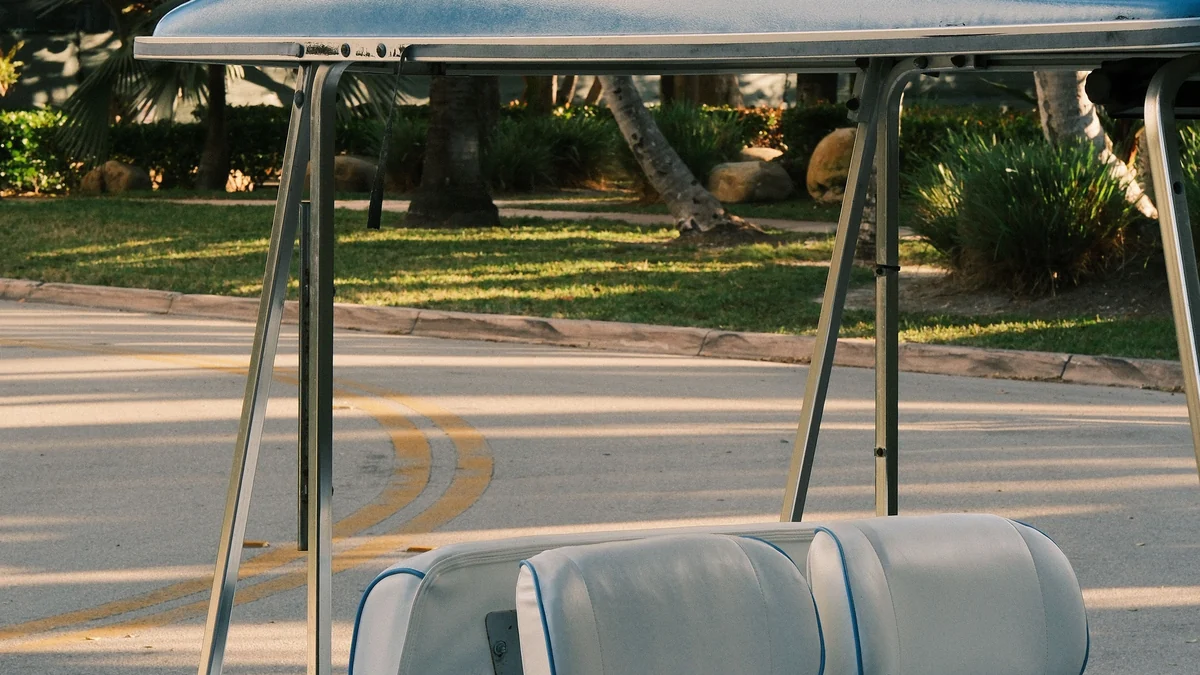
In Nocatee, a golf cart can take you to school pickup, the pools, Town Center or a friend’s house. If your family rides one, it helps to know which local rules apply, who may drive, and how the cart is insured.
Nocatee is a master-planned community in Ponte Vedra that sits in two counties. In 2001 planning records, about 11,332 of its 13,323 acres were in St. Johns County and about 1,991 were in Duval County (Jacksonville), and Nocatee now describes itself as about 14,000 acres.
We’re an independent insurance agency in Gainesville, in business since 1983, and we work with homeowners by phone, email and video. Because we’re an independent agency, a licensed member of our team may be able to compare options from the insurance companies we represent. For Florida’s statewide rules, see our motorcycle, ATV and golf cart insurance page.
Golf cart or LSV? Know which one you have
- Golf cart: Florida law defines it as a motor vehicle designed and built for golf course use that can’t go faster than 20 mph. Golf carts used under the state’s golf cart rules don’t need registration or a license plate.
- Low-speed vehicle (LSV): a four-wheeled vehicle with a top speed over 20 mph and no more than 25 mph, built to the federal LSV safety standard. An LSV needs lights, turn signals, mirrors, a windshield, seat belts and a VIN, and it must be titled, registered and insured. It may use streets posted at 35 mph or less, and the driver must have a valid driver license.
The state’s highway safety agency (FLHSMV) says an LSV needs proof of Florida insurance with at least $10,000 of personal injury protection (PIP) and $10,000 of property damage liability (PDL) to be titled and registered. A cart converted to an LSV goes through an FLHSMV inspection and VIN assignment, with forms HSMV 84490, 86064 and 82040. A cart modified to go faster than 20 mph without that process may no longer fit the legal definition of a golf cart, and both local codes that apply in Nocatee define a golf cart by the same 20 mph limit.
Where you can drive a cart in Nocatee
Nocatee says its designated roads, those with a posted speed limit of 25 mph or less, and its signed golf cart multi-use paths are for electric golf carts. Under St. Johns County Ordinance 2018-42, a cart may use a county road only if it is a designated road marked with signs or pavement markings, and the county can designate only roads posted at 25 mph or less.
- Multi-use paths (St. Johns side): carts may use a sidewalk next to a county road only if it is a signed multi-use path, with a 15 mph limit, a duty to yield to pedestrians and bicycles, and a horn or other warning device on the cart.
- Duval side: carts may use only roads or golf cart paths Jacksonville has designated and signed; check the map and the signs. Jacksonville’s code also sets 15 mph on golf cart paths, requires yielding to pedestrians and bicycles, and keeps carts off sidewalks that aren’t designated.
- The map: Nocatee posts its golf cart map at nocatee.com/golfcartmap, and Resident Services has trail maps.
Rules come from more than one place. The counties set and enforce the road and path rules, the Tolomato Community Development District (CDD) owns and maintains the trails and amenity areas, and your HOA may have its own covenants, so check those too.
At amenity centers, the CDD’s amenity policies (amended January 27, 2026) say golf carts must park in the parking lot or other designated areas and aren’t allowed on pool decks; check the CDD’s current policies.
After dark: under state law, a golf cart may run only from sunrise to sunset unless the local government allows night use and the cart has headlights, brake lights, turn signals and a windshield. St. Johns County applies that rule on its designated roads and paths, and Jacksonville’s code lists the same equipment for driving between sunset and sunrise, plus tail lights.
Equipment on any cart: Florida law requires efficient brakes, reliable steering, safe tires, a rearview mirror and red reflectorized warning devices on the front and rear. If you charge the cart in the garage, our post on garage battery charging and fire safety has practical tips.
Teen drivers: Florida’s 2023 change
Florida law changed in 2023. On public roads or streets, a golf cart driver under 18 must have a valid learner’s driver license or driver license, and a driver 18 or older must have valid government-issued photo ID. FLHSMV says the rule began October 1, 2023.
St. Johns County updated its golf cart ordinance to match, with Ordinance 2024-7, enacted January 16, 2024 and effective January 24, 2024. On the Duval side, Florida law sets the same floor for drivers under 18, and local rules can be stricter only for unlicensed drivers. Some older signs and web pages may still show earlier rules, so go by current state law and the county ordinances.
An LSV is different. LSV drivers need a valid driver license; ask before letting a learner drive one. Florida’s learner’s license rules also require a licensed driver 21 or older in the front passenger seat.
For parents, a few insurance questions are worth asking:
- Is your teen a listed or permitted driver on the cart’s policy?
- What liability limits apply if a teen driver hurts a pedestrian or cyclist on a multi-use path?
- Does your personal umbrella require certain limits on the cart’s policy?
If your teen is also starting to drive a car, our post on adding a 16-year-old driver in Florida covers the auto side.
Does my home policy cover my golf cart?
It depends on your policy’s wording, and that wording differs from one home policy to the next, so don’t assume. There is no community-wide rule. Many Florida homeowners policies cover golf carts only in narrow situations, and some exclude them. Coverage is often limited or excluded away from your residence premises, which in Nocatee can mean the roads and multi-use paths, Town Center or a friend’s house; check your wording. Damage to the cart itself, such as a collision or theft, usually isn’t covered by a home policy.
Some home insurers offer a golf cart endorsement, which may have its own limits, conditions and territory rules. Depending on your situation and your home policy’s wording, for most owners we recommend a separate golf cart policy. It’s written for the cart and can include the coverages below, so you aren’t relying on how your home policy’s wording applies.
- Liability: injuries or damage you cause to others, plus legal defense, up to your limits.
- Guest passenger: injuries to people riding with you; sometimes part of liability, sometimes a separate limit.
- Medical payments: medical bills after a covered accident, regardless of fault, up to the limit.
- Uninsured/underinsured motorist: your injuries when an at-fault driver has no insurance or not enough, where the policy offers it.
- Collision and comprehensive: damage to the cart from a crash, or from theft, vandalism or fire, minus your deductible.
- Accessories: lift kits, rear-facing kid seats and enclosures can add up, so make sure your accessories limit matches what you’ve added.
LSVs need auto-type coverage in Florida, with PIP and PDL on an auto policy that lists the vehicle, and a home policy isn’t how you meet that requirement.
Questions to ask before the next ride
- Is ours a golf cart (20 mph or less) or a titled LSV, and has it been modified?
- Do we live on the St. Johns or the Duval side, and where do we usually ride?
- Who drives it, and is each driver covered?
- Are our liability limits right for paths shared with pedestrians and bikes?
- What does our home policy say about golf carts, and does it apply away from home?
- Are our accessories covered for what they’re worth?
Send us your home policy and we’ll go through it with you, or call (352) 371-7977 or request a quote. See our Nocatee home insurance page for more on homes in the area, and if you have family in The Villages, our Villages golf cart guide covers the rules there.
Frequently asked questions
Who can drive a golf cart in Nocatee?
On public roads and designated paths, a driver under 18 needs a valid learner’s license or driver license, and a driver 18 or older needs valid government-issued photo ID.
Can I drive my golf cart on any Nocatee road?
No. On the St. Johns side, carts may use only designated, signed roads posted at 25 mph or less, plus signed multi-use paths, and on the Duval side, carts may use only roads or golf cart paths Jacksonville has designated and signed; check the map and the signs.
What is the speed limit on the multi-use paths?
The limit is 15 mph, and carts must yield to pedestrians and bicycles.
Does my homeowners policy cover my golf cart?
It depends on the policy’s wording. Coverage is often limited or excluded away from your residence premises, and some insurers offer a golf cart endorsement. Depending on your situation and policy wording, for most owners we recommend a separate golf cart policy.
What insurance does an LSV need?
An LSV must be titled, registered and insured, with at least $10,000 of PIP and $10,000 of PDL, and the driver must have a valid driver license.
Can a teen with a learner’s license drive our LSV?
LSV drivers need a valid driver license; ask before letting a learner drive one.
General information, not legal or coverage advice. Coverage depends on the policy issued, its terms and underwriting. Road and path rules are set by Florida law and local governments and can change, so follow posted signs and local rules. Sources checked October 30, 2026. McGriff-Williams Insurance is an independent insurance agency in Gainesville, in business since 1983 and licensed in Florida. We are not affiliated with Nocatee, its developer or the Tolomato Community Development District.
Sources
- Fla. Stat. s. 316.212 (2026), golf carts: https://www.flsenate.gov/Laws/Statutes/2026/316.212
- Fla. Stat. s. 316.2122 (2026), low-speed vehicles: https://www.flsenate.gov/Laws/Statutes/2026/316.2122
- Fla. Stat. s. 320.01 (2026), definitions: https://www.flsenate.gov/Laws/Statutes/2026/320.01
- Fla. Stat. s. 320.105 (2026), golf carts exempt from registration: https://www.flsenate.gov/Laws/Statutes/2026/320.105
- FLHSMV, Low Speed Vehicles: https://www.flhsmv.gov/safety-center/consumer-education/low-speed-vehicles/
- St. Johns County Ordinance 2018-42, golf carts and LSVs: https://stjohnsclerk.com/minrec/OrdinanceBooks/2018/ORD2018-42.pdf
- St. Johns County Ordinance 2024-7, amending Ordinance 2018-42: https://stjohnsclerk.com/minrec/OrdinanceBooks/2024/ORD2024-7.pdf
- City of Jacksonville Ordinance Code, Chapter 804, Part 15, Golf Carts: https://library.municode.com/fl/jacksonville/ordinances/code_of_ordinances?nodeId=896938
- Nocatee, Golf Cart Map: https://www.nocatee.com/golfcartmap
- Nocatee, How Big Is Nocatee: https://www.nocatee.com/how-big-is-nocatee
- Florida DOAH Case No. 01-1851GM, Recommended Order: https://www.doah.state.fl.us/ROS/2001/01001851.pdf
- Tolomato Community Development District: https://mytcdd.com/
- Tolomato CDD Amenity Complex Policies (amended January 27, 2026): https://img1.wsimg.com/blobby/go/ead6dfa8-684b-44e0-a1d5-9b4a7e83a011/downloads/be4c4477-cdf4-4279-b981-92c19ef4ee93/Tolomato%20Amenity%20Policies%20Approved%2012726.pdf