
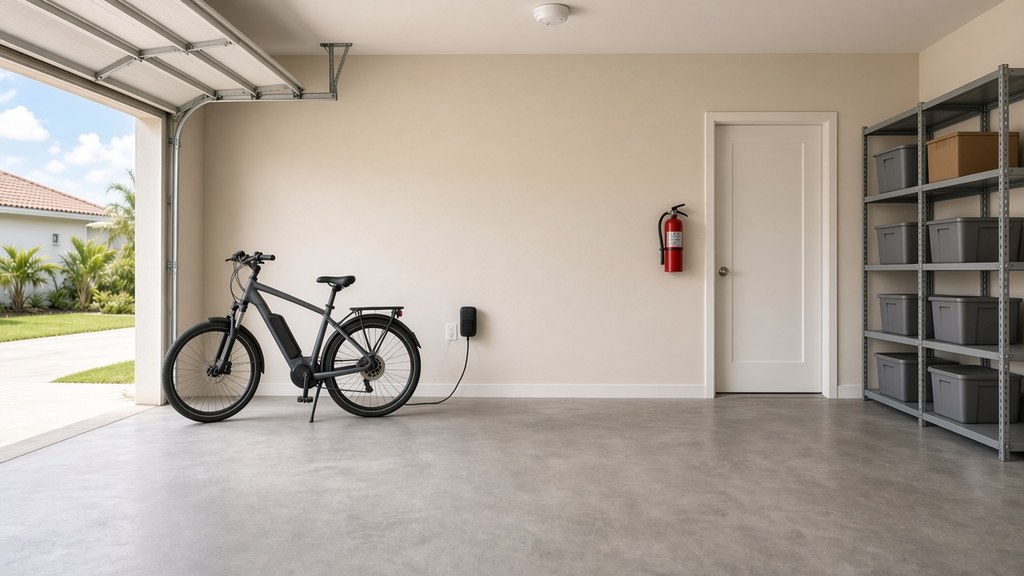
For many Florida households, the garage is where everything gets plugged in: the golf cart, the e-bike, the kids’ scooters, the mower and a shelf of power tool batteries. That makes it worth a few minutes to think about how you charge them. The CFO and State Fire Marshal’s office notes that lithium-ion batteries in devices like power tools, e-bikes and e-scooters can overheat, start a fire or explode if they’re misused, damaged or charged improperly. The U.S. Fire Administration (USFA) says garage fires tend to spread farther and cause more injuries and dollar loss than fires that start in all other areas of the home.
Here’s what public fire safety agencies recommend, and a few insurance questions to ask while you’re at it.
1. Know the warning signs
Fire safety agencies describe the same set of red flags. Stop using or charging a battery or device if it:
- Feels very hot
- Swells, bulges or changes shape
- Has a strange odor or changes color
- Leaks or smokes
- Makes hissing, popping or other odd sounds
UL’s Fire Safety Research Institute (FSRI) adds that white or gray wispy smoke means there’s an immediate danger of fire, and that from the first sign of a problem you could have less than a minute to escape a lithium-ion battery fire.
2. Charge with the right equipment
- Use the charger that came with the device, or one the manufacturer approves. The U.S. Consumer Product Safety Commission (CPSC) warns against chargers sold as “universal” or as suitable for a general category of e-bikes or scooters. They may fit but still be incompatible with your battery, which can cause a fire.
- Use the battery made for the device. CPSC advises using only replacement battery packs the device’s manufacturer confirms are suitable, and never a pack that’s been modified or rebuilt with used cells.
- Look for safety certification. NFPA recommends products listed by a nationally recognized testing laboratory. CPSC has called on manufacturers to certify e-bikes to UL 2849, the safety standard for e-bike electrical systems, and e-scooters, hoverboards and similar devices to UL 2272, the standard for electrical systems for personal e-mobility devices. Because these standards cover the device’s electrical system as a whole, look for a certification mark on the device itself, not just on a separate battery or charger.
3. Charge in the right place, and stay with it
- Outside when you can. NFPA and the State Fire Marshal’s office recommend charging large items like e-bikes, scooters and power tools outside when possible, and never where they’d block an exit.
- On a hard surface. Charge on a hard, flat surface such as a bare concrete floor or workbench, not on carpet, cushions or a pile of rags. Soft surfaces can trap heat.
- Away from things that burn. NFPA says to store batteries away from anything that can catch fire. USFA suggests keeping gasoline, oil, paint, propane and varnish in a shed away from the house, and keeping items that can burn on shelves away from appliances.
- Plug straight into the wall. USFA recommends plugging only one charging appliance into an outlet and not using an extension cord to charge.
- Be there. CPSC says to always be present while charging e-bikes and scooters and never to charge them while you’re asleep or away from home. FSRI also advises against charging larger devices overnight.
- Unplug when it’s full. Leaving a device plugged in can add heat and stress to the battery.
- Mind the heat. NFPA advises not charging lithium-ion batteries above 105°F or below 32°F. A closed garage in a Florida afternoon can get hot, so check the temperature, and your manual, before you plug in.
4. Golf carts: ventilation matters
Golf carts can use lead-acid, lithium-ion or AGM batteries, so start with the cart’s manual and the battery maker’s charging instructions. Lead-acid batteries give off hydrogen gas as they charge, and the U.S. Occupational Safety and Health Administration (OSHA) warns that it can explode if it builds up in a closed space. Palm Beach County Fire Rescue warns that overcharging, or poorly maintained batteries, can release hydrogen gas, which is highly flammable, and that charging in a garage with the door and windows closed is dangerous. Its advice:
- Charge the cart outside, at least 5 feet from the house, if you can.
- If you charge in the garage, keep the garage door or windows open, charge only when you’re home and awake, and unplug as soon as the batteries are full. Don’t charge overnight, and don’t count on a “smart” charger to shut itself off.
- For lead-acid batteries, check water levels often.
- Plug the cart directly into a GFCI outlet, and keep working carbon monoxide alarms in the home. Hydrogen from charging carts can set off CO alarms.
- If a CO alarm sounds, get out and call 911. Leave through a side door or open the garage door by hand. Don’t flip light switches or press the garage door opener, which can ignite the gas.
5. Mowers, power tools and other batteries
Lithium-ion batteries in cordless mowers, trimmers and power tools follow the same rules: the right charger, a hard surface, nothing flammable nearby, and unplugged when full. When a battery is worn out or damaged, don’t put it in the trash or your curbside recycling bin. CPSC, NFPA and FSRI all say to take it to a battery recycling or household hazardous waste location instead. NFPA notes that many stores that sell large quantities of lithium-ion batteries have recycling programs that take them back. Don’t charge a battery that shows signs of damage. If a battery or device has been damaged by water, NFPA suggests asking your local fire department, waste department or the manufacturer how to handle and dispose of it.
6. Set up the garage to warn you and slow a fire
- A heat alarm, not a smoke alarm. USFA says smoke alarms aren’t designed for garages, where changes in temperature and humidity, dust and fumes can set them off. It recommends a heat alarm rated for 175 to 250°F that’s hard-wired with battery backup, interconnected with your home’s smoke alarms and installed by a qualified electrician.
- Working smoke alarms inside the home and a home fire escape plan everyone knows.
- A fire-rated door between the garage and the house. USFA recommends a 20-minute fire-rated door that closes and latches on its own. Keep it closed.
- A fire extinguisher, used only in the right situation. USFA notes that multipurpose “A-B-C” extinguishers cover most types of home fires. Use one only when everyone in the home has been alerted, someone has called 911, you’re physically able to use it, the fire is small and contained to one object, you’re safe from the smoke and you have a clear way out. If you’re unsure, leave. Young children and older adults shouldn’t use fire extinguishers. If a lithium-ion battery is smoking or on fire, follow FSRI’s advice in the next section: get out and call 911.
7. If a battery starts smoking or catches fire
Get out. FSRI’s advice is to follow your home fire escape plan, leave immediately and call 911. FSRI’s research also shows that closing doors helps slow the spread of fire, so close doors behind you if you can on your way out. If you notice a warning sign before there’s any smoke or fire, and it’s safe to do so, NFPA suggests moving the device away from anything that can catch fire and calling 911.
8. Insurance questions worth asking
Safety habits come first, but it’s also a good time to look at your coverage.
- Fire is typically a covered cause of loss. Florida’s Department of Financial Services lists fire and smoke among the perils homeowners policies may include. Whether a particular loss is covered is subject to your own policy’s terms, including its wording, limits, deductibles and exclusions.
- Document what’s in the garage. The Department of Financial Services recommends a room-by-room home inventory that includes the garage, with photos or video, serial numbers, purchase dates and prices, updated at least once a year. Keep receipts for carts, e-bikes, mowers and tools, and store all of these records in a safe, dry place.
- Check how your golf cart is covered. Many homeowners policies limit or exclude coverage for motorized vehicles, and golf carts often fall into that category, both for damage to the cart and for liability. Whether your policy applies can depend on its wording and on how and where the cart is used, such as on a golf course, around your neighborhood or on public roads. Florida law defines a golf cart as a vehicle made for golf course use that can’t go faster than 20 mph. A low-speed vehicle, with a top speed over 20 and up to 25 mph, must be registered, titled and insured to be driven on the road. Depending on your policy and how you use the cart, you may need an endorsement or a separate policy, and either one has its own terms and exclusions. For example, it may not cover a battery or charger that wears out or fails on its own. E-bikes and e-scooters can raise similar questions, even though Florida law treats e-bikes much like bicycles. Before you assume your home policy applies, a licensed member of our team can review how it treats your cart and other battery-powered equipment.
FAQ
Is it safe to charge an e-bike in the garage?
Fire safety agencies recommend charging e-bikes and scooters outside when possible. If you charge in the garage, use the manufacturer’s charger, charge on a hard surface away from anything flammable and away from exits, stay home and awake while it charges, and unplug it when it’s full.
Should I put a smoke alarm in my garage?
USFA recommends a heat alarm rather than a smoke alarm in the garage, interconnected with your home’s smoke alarms, because garage conditions can trigger false smoke alarms.
Does my homeowners policy cover my golf cart?
It depends on your policy and on how and where you use the cart. Many homeowners policies limit or exclude motorized vehicles, and in Florida, a low-speed vehicle (top speed over 20 and up to 25 mph) must be registered, titled and insured to be driven on the road. Some owners need an endorsement or a separate policy, which has its own terms and exclusions. A licensed member of our team can review how your current policy treats your cart.
Let’s review your coverage
McGriff-Williams Insurance is an independent agency in Gainesville since 1983. If you keep a golf cart, e-bikes or other battery-powered equipment at home, a licensed member of our team can review your current home and auto coverage with you, including how it treats them. Call (352) 371-7977 or contact us.
This article is general information, not a statement of coverage. Your policy’s terms, conditions and endorsements control. Coverage options vary by company and are subject to underwriting and availability. Safety tips are general; always follow your device manufacturer’s instructions and your local fire officials. Information is as of October 22, 2026.
Sources
- Florida Department of Financial Services, “Chief Financial Officer and State Fire Marshal Blaise Ingoglia Highlights 2026 Fire Prevention Week, ‘Charge into Fire Safety. Safe Charging is a Superpower'” (Oct 5, 2026), accessed Oct 22, 2026: https://www.myfloridacfo.com/news/pressreleases/press-release-details/2026/10/05/chief-financial-officer-and-state-fire-marshal-blaise-ingoglia-highlights-2026-fire-prevention-week---charge-into-fire-safety.-safe-charging-is-a-superpower
- U.S. Consumer Product Safety Commission, “Micromobility: E-Bikes, E-Scooters and Hoverboards,” accessed Oct 22, 2026: https://www.cpsc.gov/Safety-Education/Safety-Education-Centers/Micromobility-Information-Center
- U.S. Consumer Product Safety Commission, “CPSC Urges Consumers to Not Buy or Use ‘Universal’ Chargers with Micromobility Products Due to Fire Hazard” (Sept 5, 2024), accessed Oct 22, 2026: https://www.cpsc.gov/Newsroom/News-Releases/2024/CPSC-Urges-Consumers-to-Not-Buy-or-Use-Universal-Chargers-with-Micromobility-Products-Due-to-Fire-Hazard
- U.S. Consumer Product Safety Commission, “CPSC Calls on Manufacturers to Comply with Safety Standards for Battery-Powered Products to Reduce the Risk of Injury and Death” (Dec 20, 2022), accessed Oct 22, 2026: https://www.cpsc.gov/Newsroom/News-Releases/2023/CPSC-Calls-on-Manufacturers-to-Comply-with-Safety-Standards-for-Battery-Powered-Products-to-Reduce-the-Risk-of-Injury-and-Death
- NFPA, “Lithium-Ion Battery Safety,” accessed Oct 22, 2026: https://www.nfpa.org/education-and-research/energy-transition/lithium-ion-batteries
- NFPA, Fire Prevention Week 2026 tip sheet, “Safe Charging Is a Superpower,” accessed Oct 22, 2026: https://www.nfpa.org/-/media/Project/Storefront/Catalog/Files/Fire-Prevention-Week/2026/FPW26_Tip-Sheet.pdf
- NFPA, “Lithium-Ion Battery Safety” tip sheet, accessed Oct 22, 2026: https://content.nfpa.org/-/media/project/storefront/catalog/files/safety-tip-sheets/lithiumionbatterysafetytips.pdf
- UL Research Institutes’ Fire Safety Research Institute, “Take C.H.A.R.G.E. of Battery Safety,” accessed Oct 22, 2026: https://batteryfiresafety.org/
- U.S. Fire Administration, “Basement and Garage Fire Safety” (last reviewed April 1, 2023), accessed Oct 22, 2026: https://www.usfa.fema.gov/prevention/home-fires/prevent-fires/basement-and-garage/
- U.S. Fire Administration, “Heat Alarms” (last reviewed April 1, 2023), accessed Oct 22, 2026: https://www.usfa.fema.gov/prevention/home-fires/prepare-for-fire/heat-alarms/
- U.S. Fire Administration, “Choosing and Using Fire Extinguishers” (last reviewed April 1, 2023), accessed Oct 22, 2026: https://www.usfa.fema.gov/prevention/home-fires/prepare-for-fire/fire-extinguishers/
- UL Research Institutes’ Fire Safety Research Institute, “Close Before You Doze,” accessed Oct 22, 2026: https://closeyourdoor.org/
- U.S. Occupational Safety and Health Administration, “Powered Industrial Trucks eTool: Power Sources – Electric,” accessed Oct 22, 2026: https://www.osha.gov/etools/powered-industrial-trucks/types-fundamentals/power-sources/electrical
- Palm Beach County Fire Rescue, “Golf Cart Safety,” accessed Oct 22, 2026: https://discover.pbc.gov/pbcfr/CRRD/Pages/Golf-Cart-Safety.aspx
- Florida Department of Financial Services, “Homeowners’ Insurance: A Toolkit for Consumers” (perils list p. 4; home inventory pp. 19–20), accessed Oct 22, 2026: https://www.myfloridacfo.com/docs-sf/consumer-services-libraries/consumerservices-documents/understanding-coverage/consumer-guides/english---homeowners-insurance-toolkit.pdf
- Florida Statutes s. 316.2122 (low-speed vehicles) and s. 320.01(22) and (41) (definitions), accessed Oct 22, 2026: https://www.flsenate.gov/Laws/Statutes/2026/316.2122 and https://www.flsenate.gov/Laws/Statutes/2026/320.01
- Florida Statutes s. 316.20655 (electric bicycles), accessed Oct 22, 2026: https://www.flsenate.gov/Laws/Statutes/2026/316.20655